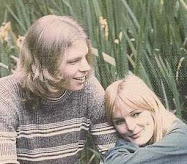
to you who write comments that always encourage me to add something else. I always think there may be nothing else I could add but then when you write I feel joy and try finding something I had not shown. I thank you for wanting to see more, Ingrid
Monday, January 17, 2011
A thank you
to you who write comments that always encourage me to add something else. I always think there may be nothing else I could add but then when you write I feel joy and try finding something I had not shown. I thank you for wanting to see more, Ingrid

Thursday, December 23, 2010
Temporary entry
 To create a new entry seems more difficult over time because much has been shown and shared but then an idea developes and that energy is wonderful. This is to say my brain is working on hopefully an interesting addition but having first to reread previous entries so not to repeat myself. This is also an opportunity to wish everyone a good and creative New Year. It is so wonderful for me to be in touch with so many marblers.
With best wishes, Ingrid
Saturday, November 13, 2010
Bullseye
 Every marbler who encounters extreme fluctuations with weather, from moist to suddenly very
dry knows about paper turning too dry and dust problems unless you have a controlled environment. It was a constant struggle for Christopher in this climate so when it was a perfect day for marbling after having prepared papers and colors days ahead it was a joy for him when everything worked. This 18X24 piece was one of those days. No intention for achieving patterns that day but to see how the colors worked.
Monday, October 4, 2010
Steps to Paris
In 1985 Christopher was asked to contribute if possible a modern design for an exhibition in Paris to be shown in December 1985. As many marblers achieve a pattern by continuous steps arriving at the desired pattern it never occured to me to show how Chris arrived at his final paper he named Paris for the exhibition until I explained it to Vi Wilson, a marbler from Australia who was visiting me and who said it was very interesting to see how he arrived at the final design. I decided to show the 4 papers (approx.size 19"x 25")that let up to the one he decided is the one.
 So here is the first attempt above.
  I do not recall over how many weeks or month his attempts took at arriving what he hoped to achieve. Here another step above.
 I remember at this point he started to like what he had created but felt it wasn't modern enough.This lovely pattern was shown on the cover for the Second International Marblers'Gathering Exhibition in San Francisco, 1992.
  If I remember correctly he nearly felt he had it with the one above but the background was too busy so he marbled on to arrive finally at Paris below.
  Exhibited in Les Arts Du Livre d'Hier a Demain (Atelier d'Arts Appliques du Vesinet) Honorary degree for "Paris" paper. Exhibiton shown at the Museum of Luxembourg, Paris. In March of 2011 when Vi Wilson returned for 6 days to help me categorize Christopher's work for a collection and detailing works we noticed there were many attemptet steps to arrive at the final design and as we talked about how he went about it she wrote: "These papers were not created by successive over-marbling, but the different elements ( leaves, flowers etc.) were progressively added to the previous layer/s of color/pattern on the size. The completed pattern was then transferred to a sheet of paper". Vi Wilson
Tuesday, September 21, 2010
Passion
 It has come to my attention that a miniature painting Christopher recreated to learn how it was made is in the collection at the Brooklyn Museum: http://www.brooklynmuseum.org/opencollection/objects/127707/Stalling_Elephant/set/?referring-q=elephant=
It belonged to Dr. Bertram Schaffner who had it hanging in is office for many years before it was donated to the Brooklyn Museum. He allowed Chris to publish his findings in his Fine Print article of Oct.1983, Volume Nine, Number Four. It was one of the first multiple stenciled pieces Chris was intrigued with and wanted to study and learn how to make. Some years later he met Dr.Schaffner in person in NY city and saw the original. Dr.Schaffner felt he should put the painting in a safe after discussing all that he learned about the miniatures so he said to Chris "Thanks a lot Christoper, now I cannot enjoy it on my wall anymore" with a smile I'm sure.
"Stalling Elephant with Two Riders is an excellent example of a painting produced by the stencil method, in this case by means of four different stencils. While all four marblings are in tarakli-ebru pattern and were made with the same comb, variety was achieved by combing the pattern in varying directions and by using different colors for each marbling. The marbler used a single comb with a pin spacing of approximately one millimeter. The two riders were produced with the first stencil, the top blanket was shaped by the second stencil, and the under blanket by the third; the fourth stencil created the elephant's body. After each of these stencil applications, the marbled paper was thoroughly rinsed, dried, pressed, and recoated with a solution of alum. The fourth pattern is particular interesting because several "skips," long solid lines, appear in the tarakli-ebru pattern. A skip results when a marbler lifts the comb out of the size for a short interval and puts it in again as he pulls the comb across the colors. (Skips are also prominent in the marbling of the four paintings of emaciated horses.) Obviously the artist gave a great deal of thought to how he could achieve life and movement in his painting through marbling. After the marbling was completed, the remaining details were drawn in by hand. The stencils need not have been applied in the order given here, but I found that using them in any other sequence would have meant covering a larger area at each marbling to mask what had been marbled previously. In those marbling processes where a stencil must be glued onto previously marbled areas of the paper, great care must be exercised while soaking and peeling away the stencil; removing the stencil too quickly could damage the marbling." (Christopher in Fine Print, in above mentioned issue.

Christopher's passion for learning, the challenges of what had been done hundreds of years before him, the joy of discovering and sharing and now being quoted in a museum surely would make him smile and be proud. I want to thank Jake Benson for inspiring this entry by letting me know of the piece's web access.
Monday, March 29, 2010
Beyond Endpapers
 At first Christopher's goal was to be able to make patterned papers with the intend of selling them as endpapers. For years we searched in Bookstores, Libraries, Art stores and the like to find patterns or the history of them.
We spent endless weekends browsing these places and then one day in the mid 1970's we came upon the first marbled miniature painting and from that moment on Chris was determined to find out anything he could about these, find as many as possible and the owners as well. Contact with the first one we had seen in a catalogue at LACMA took a year to finally meet Dr. Edwin Binney,3rd at the San Diego Museum of Art (with Chris above signing the catalogue)where Chris for the first time saw the original and others in his collection. He then knew that they were not collages but in fact marbled with stencil, resists or both. In time he proofed it to be correct by recreating them and later on by the generosity of Dr. Binney to loaned to the LA County Museam of Art and Chris had to conince them that it was worth to have them analyzed by X-ray flourescence. They were indeed made the way Chris had thought from the beginning and by lecturing with slide shows showing the steps and an article in the Stanford Imprint 1982, Fine Print 1983, to just mention a few, he shared what he learned.The above inscription by Dr.Binney,3rd with Chris in San Diego reads "For Chris with many thanks for what you are doing, 1978."  And in 1980 Dr. Binney again thanks Christopher fondly for his help to understanding how they were made because he had written:"The elements in the scene, in addition to their marbling, are cut out and pasted on the background-a marbled, decoupe album page. Our lack of knowledge as to exact location in no way detracts from the aesthetic mastery of these leaves. But it would still be helpful to find a 'willing hand' to fill in still another gap in our knowledge of Deccani painting."**Indian Paintings From The Deccan. A lecture by Edwin Binney, 3rd, PhD for The Royal Society of Arts Journal, Nov. 1979.
 And in 1980 Dr. Binney again thanks Christopher fondly for his help to understanding how they were made because he had written:"The elements in the scene, in addition to their marbling, are cut out and pasted on the background-a marbled, decoupe album page. Our lack of knowledge as to exact location in no way detracts from the aesthetic mastery of these leaves. But it would still be helpful to find a 'willing hand' to fill in still another gap in our knowledge of Deccani painting."**Indian Paintings From The Deccan. A lecture by Edwin Binney, 3rd, PhD for The Royal Society of Arts Journal, Nov. 1979.
 The enthusiasm of these two people after they met and shared, one the Collector and Chris the marbler I shall never forget. Chris was the "willing hand" by his excitement for learning as much as possible.After Chris completed his first slide presentation of how he thought the miniatures were made he then took it to San Diego to show it to Dr. Binney and he gave him a gift of one creation of the three stenciled steps of the "Tiger Eating A Gazelle surrounded By Deer"(below). I don't believe Chris even signed the pieces, he was just simply happy to be able to share, that's how he was. It wasn't fame he was after, not even trying to leave a mark, simply to learn and do projects. At that point he wanted to create miniatures, trying various printing techniques to be able to do a limited editon of originals. However, sadly, time was cut short.
Tuesday, February 23, 2010
Sorting tossing keeping
 Working with ideas of what to share and show next. I'm finally once again going through thousands of slides that were part of Chris's lectures. So old fashioned in a way today, it took so much time then for information and assembling, years really. Today it's the click of a mouse. I feel it is all about sharing and inspiration no matter how old or new. Using two projectors came close to making it look like a movie and the visuals were inspiring for sure. Basically it is all about how a determined person continues to accomplish his curiosity with enthusiasm and works at it for many years and finally accomplishing it through hard work teaching himself and sharing it enthusiastically with others.
 Mostly no financial gains but always hoping to make a living.
To witness his energy and understand his vision has been the joy of my life.
Subscribe to:
Posts (Atom)